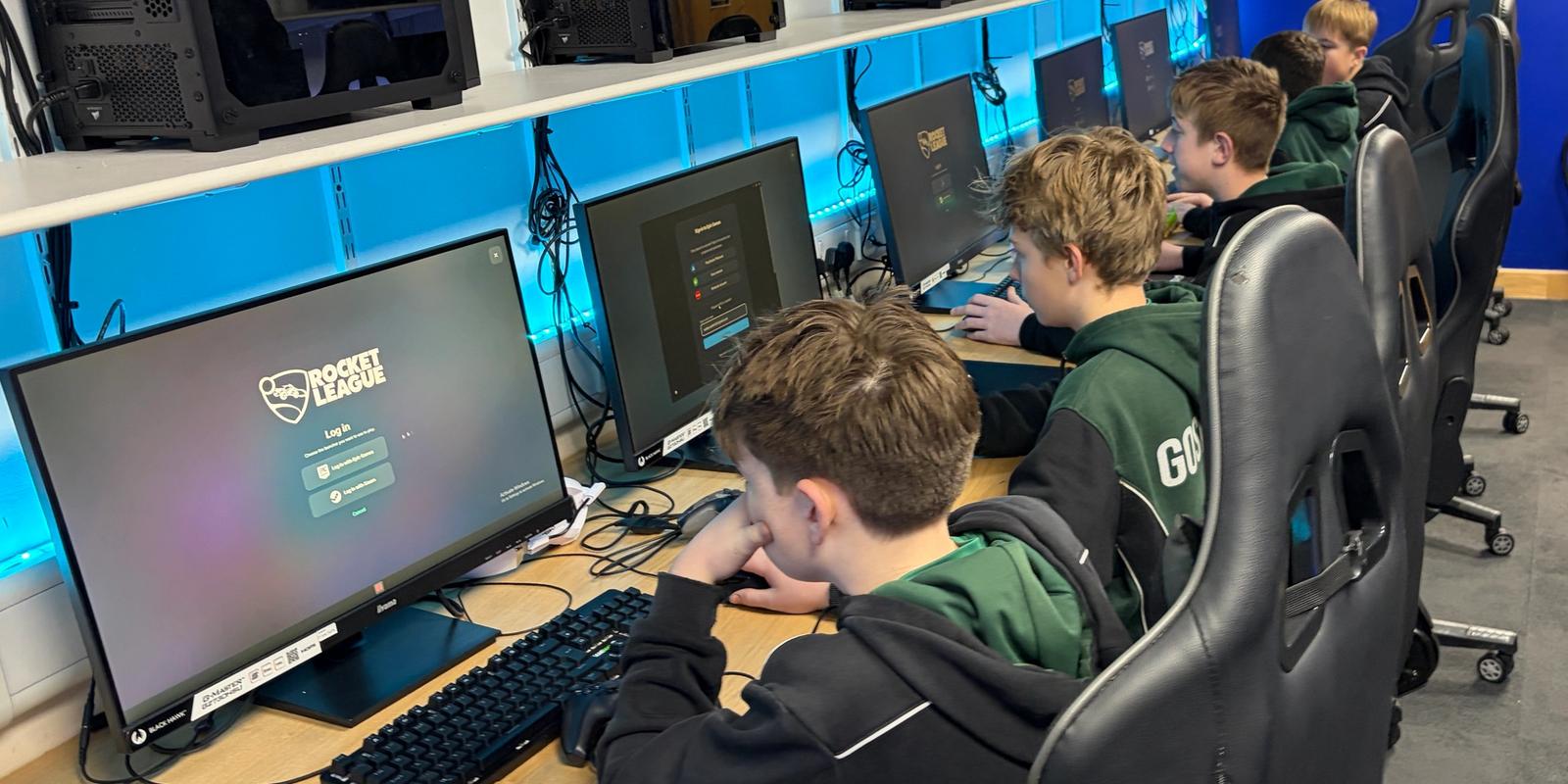
Small School, Big Aspirations: How Gosfield School Arrived at the World Championships
Guy Colnbrook heard about DAIGON in Dubai, made a note, and filed it away. Two years later, a batch of Amazon controllers and a handful of Year 9 students who liked Rocket League later, Gosfield School is going to Malta.
School Blog Profile | DAIGON Esports | SEWC 2026
Guy Colnbrook first heard about DAIGON in Dubai.
He was working at a school in the Middle East when the name came onto his radar. He made a note of it. Then he moved back to the UK, and there was the name again, this time on the ISA esports competition. He remembered what it was about.
“I thought,” he says, “okay, we can have an explore of this.”
He approached a group of Year 9 students he knew liked playing Rocket League and Minecraft. Would they like to take part in a competition?
They would. A few months later, he took them to York.
They came back with third place. And when the rest of Gosfield School heard about it, everyone wanted in.
The School That Said Yes
Gosfield School sits in 110 acres of Essex parkland. Alongside its strong academic results and renowned Outdoor Learning provision, the school offers thriving Cricket, Netball and Performing Arts Academies, providing pupils with exceptional opportunities to develop their talents and pursue their passions.
When Guy came to the principal, Rod Jackson, with the idea of an esports programme, he was not sure what to expect. He did not need to worry.
“My principal has been very supportive,” Guy says. “He can see how our pupils really enjoy esports. Lots of the pupils who enjoy that competitive nature of school life really enjoyed esport. And it was a great opportunity for pupils who maybe aren’t into cricket and our traditional sports to take part in the virtual esports world.”
No resistance. No long conversation. The answer was yes.
For a school that already runs across the full competitive spectrum, from cricket to netball to performing arts, creating a dedicated pathway for those whose interests and aspirations lie beyond these disciplines was a logical step.
What Fifty Minutes Looks Like
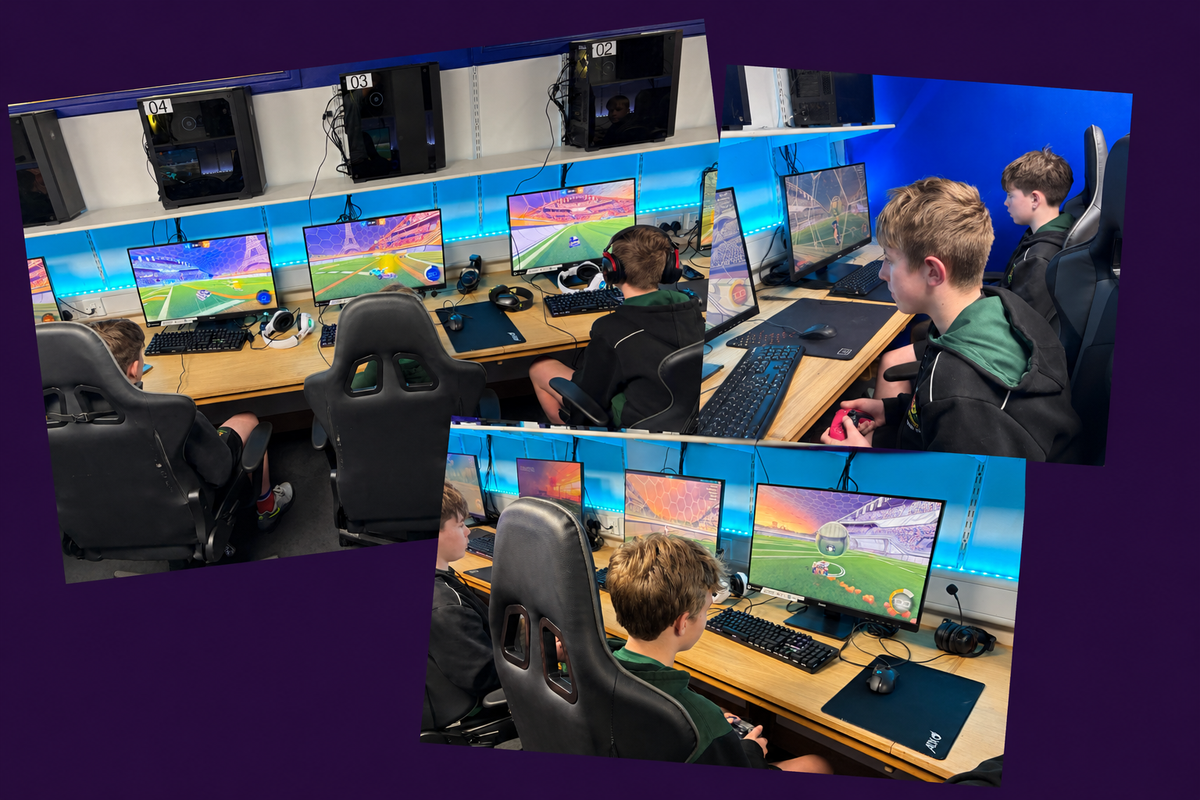
Both the prep school and the senior school now have a dedicated esports club, each running once a week for fifty minutes. That time is carefully structured.
The first ten minutes are a warm-up, students playing against bots to sharpen their instincts before anything competitive begins. Then codes are shared. The room splits into groups of three, mirroring the format of the actual Rocket League competition. Internal matches begin. Results go into a spreadsheet.
The spreadsheet matters. It is how Guy tracks who is winning and who is not, so that in the second and third rounds of a session, teams are matched fairly. A team that has just been beaten faces another team that has just been beaten. A winning team faces a winning team.
“That’s it,” Guy says. “It’s not just as and when they like or multiple clubs in a week. It’s a purposeful fifty minutes of practice and matches.”
The prep school competes in Minecraft. The senior school competes in Rocket League. Up the school, different games, same discipline.
Cricket Scholars and Computing Students
The room that gathers on esports day at Gosfield is not what you might assume.
Guy describes it as a real mix. There are pupils who love coding and computer science, drawn naturally to the competitive logic of a structured game. And then there are the cricket scholars.
“A lot of the qualities they demonstrate on the cricket pitch, they’re able to translate into esports,” Guy explains. “They’ve really enjoyed the opportunity to demonstrate their skills and take part in competitions and to develop their skill sets.”
Composure under pressure. Reading the opposition. Performing when it counts. It is the same requirement, different arena.
The Year 11 Who Showed Up Anyway
There is one student in the Gosfield esports programme who stands apart from the rest, not because of his results, but because of what he was willing to do to stay involved.
He is now in Year 11. He is the only student from his year group who takes part in esports at the school. Every other player in the programme is younger than him.
It has not deterred him.
“He hasn’t let that deter him,” Guy says. “He was one of our most successful players in the build-up to the esports competition at York. And he’s coming to Malta as well. So it’s been brilliant to see that. Although he’s the only pupil from his year group, he hasn’t let that deter him. Working with year groups below him to form a successful team.”
He is going to Malta as one of the best players the programme has produced.
Two Hundred Pounds and a Headache
One of the quieter parts of the Gosfield story is what it cost to get started.
The school had recently replaced the computers in the computing room, and Guy had been able to arrange a modest upgrade at the time of purchase: 16 gigabytes of RAM, just enough to support everything Rocket League and Minecraft would need.
The only thing that required additional spending was controllers. Guy ordered a batch off Amazon.
“About £14 per controller,” he says. “Let’s say £200 it cost to get it going.”
The licence for the game was already covered under the school’s existing agreement. The financial barrier, for a programme now heading to a world championship, was two hundred pounds and an afternoon in the computer room.
The ongoing cost, however, is time.
“Having it updated on enough computers has been a bit of a headache,” Guy says. “Rocket League, for some reason, you can’t just install it. Every two weeks, they seem to update it. So it’s 22 computers, having to update them and log in with the administrator.”
Gosfield is a small school. It is Guy and one technician. Every fortnight, they go around every machine together.
York
The ISA National Esports Final at York was the first real test of what Guy had built.
He had entered four teams. The competition was not one-sided. In one match that stayed with the players long after it ended, Gosfield faced a French or Swiss school in a back-and-forth contest that neither team dominated.
“It was a real back and forth the whole match,” Guy says. “It wasn’t dominated by one side. Both teams at different points during the match were in the lead. And then they were able to get a couple of goals right at the end, and win.”
The players were not disheartened. They had competed properly, in a real contest, against a team that pushed them. That, for a programme in its first year, was the point.
One of the four teams made it through to the semifinals. Then to the final. Overall, Gosfield finished third.
The news of the semifinals came first by email. Guy announced it to the club the following day. At York, when all the schools gathered together, third place was announced from the stage, alongside the news: Gosfield School was going to Malta.
“They were extremely excited,” Guy says. “Everyone was really excited. I sent some information to marketing to share on socials, saying yes, we’ve got through. We’re going to Malta in November.”
What Changed at School
When Gosfield came back from York with a result and a place at the world championship, something shifted.
The younger pupils in the prep school, Years 5 and 6, started paying attention. The idea that you could join the esports team and end up competing at a world level was no longer abstract.
“It’s really aspirational,” Guy says. “The younger pupils, particularly in the prep school, to see what they’re able to accomplish if they join the esports teams here at Gosfield.”
For Guy personally, the result meant something specific. He joined the school two years ago. Before he arrived, not a single student was choosing computer science as a GCSE.
“Now we’re up to double digits over the last three years,” he says. “It’s impressive to see how computer science and esports is now being recognized as something important, and something that the school invests in, and celebrates.”
The parents have engaged too. Mothers and fathers whose children spend hours at home on Rocket League had found themselves watching their child compete in a structured programme and earn a place at an international championship.
“They said, oh, my child does this all the time. It’d be great if they can get involved,” Guy explains. “And parents who have seen their children playing these games all the time now are quite appreciative that they’re going to be recognized for that. It’s not just been lost time in their bedroom playing on the game. Actually, they can maybe win something and have some record for it.”
Malta and What It Means
Gosfield School has been to international competitions before. They have won awards for sporting provision in a small school. They have won awards for performing arts productions and taken home the titles of Best Actor and Actress. They have travelled to Dubai, Latvia, the Faroe Islands.
But an esports world championship is a first.
“This is the first academic one we’ve taken part in,” Guy says.
More than that: it is the moment that computing gets its place in the story of the school.
“Computing is something that has sort of not been recognized in the past,” Guy says. “But now it’s going to be seen alongside performing arts and sport. It’s really nice for computing and digital learning to be recognized as something that the school does really well.”
“Taking part in the World Championships means so much to me. When my previous school closed, I honestly thought my competitive esports days were over. Rocket League had always been something I loved, and I never expected to have the chance to compete as part of a school team again. When I joined Gosfield School and found out there was already an Esports team, I was over the moon. Being given the opportunity to join the team and help them reach the final has been amazing. At first, I was quite nervous because I didn’t know the other players and I was only ranked C3 in Rocket League. I worried that I might not be good enough, but I quickly realised that my level was more than acceptable and that everyone was really supportive. The team made me feel welcome straight away, and we’ve worked hard together to improve. Preparing for the World Championship is something I never imagined would happen, and I’m incredibly excited to represent Gosfield School in Malta.”
A student, Gosfield School
What Comes Next
The programme Guy is building at Gosfield has a clear direction.
In the near future: steering wheels and pedals for racing esports, joysticks for flight simulators, a couple of more powerful machines for live streaming. Two clubs per division rather than one: Minecraft and another for the prep school, Rocket League and another for the senior school.
A virtual league with local schools, held online to avoid the scheduling difficulties that away fixtures create, is already in planning. When the ISA qualifiers return, Guy expects more than one team heading to the final.
“As I mentioned, we’ll have a few more teams qualifying,” he says. “We have such a diverse array of pupils who want to be involved.”
What Guy Wants You to Know
At the end of the call, Guy was asked the question that closes every interview in this series: when someone reads this profile and thinks about Gosfield School for the first time, what do you want them to feel?
He paused for a moment, and then he gave an answer that said everything.
“We’re a small school, but with big aspirations.”
He wants computing to be seen. He wants the school to be known for more than cricket and performing arts and winning performing arts awards, which it already does very well.
“This is our first time taking part in the competition,” he says. “It won’t be our last.”
“I am absolutely delighted that Gosfield School has the opportunity to represent itself on the world stage at the School Esports World Championships in Malta. Throughout our history, we have rightly celebrated excellence in Sport and Performing Arts and those areas continue to thrive, but it is equally important that we recognise and champion the talents of pupils whose passions lie in the digital world. Esports provides a fantastic platform for developing teamwork, communication, resilience, strategic thinking and leadership, all skills that are highly relevant both in education and beyond. Seeing our pupils qualify for an international final in only the second year of the Daigon/ISA Esports programme is a tremendous achievement, and I am incredibly proud that we are expanding the opportunities available to our pupils. For me, this is another exciting step forward as Gosfield School continues to embrace innovation while remaining true to our commitment to helping every pupil find and develop their strengths ahead of our centenary celebrations in 2029.”
Rod Jackson, Principal, Gosfield School
A school that started with a conversation in Dubai, a batch of controllers from Amazon, and a handful of Year 9 students who liked Rocket League is heading to Malta in November. Gosfield did not have a dedicated esports arena. It did not have a specialist hire. It had a teacher who saw something, a principal who said yes, and students who were ready.
Sometimes that is enough.
Gosfield School competes in Rocket League at the School Esports World Championships 2026, Malta, November 18 to 23. Gosfield qualified through the ISA x DAIGON Esports Competition.
Interested in bringing DAIGON to your school?
Book a call